The GEO Tactics That Quietly Destroy Your SEO (and What to Do Instead)
On March 18, 2026, SEO specialist Lily Ray published a Substack article called "Your GEO Strategy Might Be Destroying Your SEO." GEO, short for generative engine optimization, means getting a brand named in the answers that ChatGPT, Perplexity and Google's AI features write. Ray's point was that several popular GEO tactics wreck the Google rankings those answers depend on.
I work at RankControl, an AI SEO and AEO platform, and on March 20, 2026 our team published its own version of that warning for founders chasing AI search visibility. This post rewrites ours. On November 19, 2026, I re-read Google's guide to AI features in Search (last updated July 10, 2026), Google's documentation changelog, Bing's webmaster guidelines, studies from Ahrefs and Semrush, and Ray's articles from March 18 and May 13, 2026. Where a page and our post disagreed, I went with the page, and five claims changed.
Why founders pivot to GEO
The pitch usually starts with a conversion number. A Semrush study published on July 21, 2025 found that the average AI search visitor, meaning a visit tracked to a non-Google source such as ChatGPT, is worth 4.4 times the average organic search visit by conversion rate. We narrowed that to ChatGPT visitors in March, and Semrush had built the figure from more than 500 digital marketing and SEO topics. A SaaS founder sees that number and the headlines about AI eating into Google, then hires a GEO agency or copies a viral thread about optimizing for Perplexity.
What follows, in the sketch we gave in March, is a 30% drop in Google organic traffic within three months while AI citations stay flat, so the company ends up behind on both channels. That scenario is a composite, but Ray's May 13, 2026 article documents the real thing. Ray tracked more than 220 websites named as customers of AI content-scaling tools and found that 54% lost at least 30% of their peak organic traffic, 39% lost at least half and 22% lost at least 75%. Typically, six to twelve months of fast page growth gave way to a traffic peak and then a steep fall within a year, a shape Ray, citing Glenn Gabe, calls "Mount AI."
Ray notes the limits: the traffic figures are third-party Ahrefs estimates, and the pattern is a correlation, not proof that any one tool caused any one drop. We added two figures from our own tracking, that Google drives 50 to 90% of organic leads for most B2B SaaS companies and that AI referrals are under 1% of traffic for most websites. I did not re-run that tracking, so the first stays our claim. The second has outside support: Ahrefs reported on May 15, 2026 that all AI chatbots combined sent 3.5 million visitors in March 2026 across the 74,752 websites in its chatgpt-vs-google.com tracker, which is 0.28% of total web traffic.
Ray also points to two kinds of gotchas with GEO success stories. One is pretending old SEO stuff (like structured data, FAQ schema, clear headings & direct answers) are novel GEO inventions. The other is to take credit for GEO for AI citations you already got with current rankings. So for example, you have a brand with years of authority and good backlinks and now it's showing up in ChatGPT answers and the brand's new agency takes credit and it's more likely because of your SEO visibility that got it in those indexes which power those products.
Four tactics that can cost you rankings
Ray's article lists five. Our March post chooses four. Two of them are the same as Ray's (scaled content and comparison pages). The FAQ schema and AI readability are our ideas. Here, I'll try to say where the evidence I could check is lacking.
1. Thin pages made to be cited
The most common play is a batch of dozens of pages, each 400 to 600 words, answering one narrow question an AI might be asked. Google's spam policies (read November 19, last updated August 28, 2026) define scaled content abuse as pages generated "for the primary purpose of manipulating search rankings and not helping users," and say that holds "no matter how it's created," so it doesn't matter whether a person or GPT wrote them. Google's AI guide names this habit directly: separate content for every search variation, made primarily to manipulate rankings or AI responses, "violates Google's scaled content abuse spam policy." We have watched sites that published 50 thin pages in a month lose 40 to 60% of their indexed pages within two core updates, a figure from our own tracking that I can't verify publicly.
Ray's March 18 article has dated cases of the same shape: three sites whose organic traffic fell after case studies praised their AI-scaled content, drawn from roughly 30 such examples. One of them removed the very articles its case study celebrated, which Ray ties to a large traffic drop in February 2026. A page that exists only so ChatGPT will cite it gives Google every reason to demote it, because Google wants depth, original insight and real expertise.
2. FAQ markup on every page
It starts with 'AI Models love FAQ schema' which is that hidden code that identifies Q&A's for search engines but finishes with 15 FAQ's on the page, even if the questions don't quite fit in that way. In March we had stated that Google was already cracking down on FAQ rich results (these are the extra Q's you see as extended boxes below the search results) since 2023. It was stated that having too many of these could indicate that you're being manipulative. Google did announce on the 8th August 2023 that only well known Government and Health sites would display FAQ rich results. And then the changelog goes on to say this feature won't be available from May 7th, 2026 and it was removed from docs on the 15th June 2026. So no more boxes for the results that used to get FAQ markup.
The ranking claim is where the page and our post part ways. Google's structured data guidelines (updated July 10, 2026) describe a structured data manual action as the penalty for markup that breaks its rules. It means a page "loses eligibility for appearance as a rich result; it doesn't affect how the page ranks in Google web search." Google's AI guide adds that structured data "isn't required for generative AI search." I found no Google statement that heavy FAQ markup lowers rankings or hides a site from AI crawlers, so I treat both as unproven. Bing is stricter: its guidelines say misleading structured data "may be ignored and can affect trust and eligibility for enhanced features."
The FAQ with teeth is the FAQ farm, 1 question per page, the answer is in the first paragraph, there's schema at the bottom, it's one of the eight templates of Ray's May 13 list of declining sites. Ray guessed Google responded to that flood of them the week before by deprecating FAQ. So, again, it's the scaling of content (markup's incidental). Still, our guideline is don't use FAQ questions unless it helps readers, max 4-5 questions per page, don't use it on product pages, landing pages and any page that uses it for SEO padding.
3. Rewriting a page that already ranks
This one hurts most because the intention is good. Take a page ranking third for a competitive keyword. Its owner reads that AI models prefer definition-first content, rewrites the intro, strips out the nuance and turns expert analysis into a Wikipedia-style summary. In our scenario the AI citation rate stays flat and the Google ranking falls to page 2.
I found no published dataset on this pattern, so the evidence is indirect. Google's helpful content page (updated October 5, 2026) points to E-E-A-T, short for experience, expertise, authoritativeness and trustworthiness, and warns against search engine-first content. Google's AI guide says "You don't need to write in a specific way just for generative AI search," which makes the rewrite unnecessary without proving it costs rankings. Our explanation is that detailed, opinionated, experience-driven writing is what shows those qualities, so stripping it out removes signals Google uses. The fix is additive: keep the expert text, add a direct-answer summary at the top and an FAQ block at the bottom.
4. Comparison and alternatives pages by the dozen
The playbook is dozens of "[Your Product] vs [Competitor]" and "[Competitor] alternatives" pages, each aimed at a different AI query pattern. A few are ordinary competitive SEO. We draw the line at 20 or 30 pages on one template with thin content, and we have seen sites publish 40+ comparison pages in a single quarter and then watch their domain authority (a third-party score of site strength, not a Google metric) fall. The two traps are repackaging the same content under new headers and building pages for competitors your audience doesn't compare you against.
Ray wrote on March 18 about a site that made 51 comparison and alternatives pages through 2025, where the blog's organic traffic and ChatGPT citations both started to slip in late January 2026.
Plus, Ray also said, "The problem isn't the tactic itself; it's the scale." The policy about doorway abuse by Google is a match for the templated version; "substantially similar pages that are closer to search results than a clearly defined, browseable hierarchy."
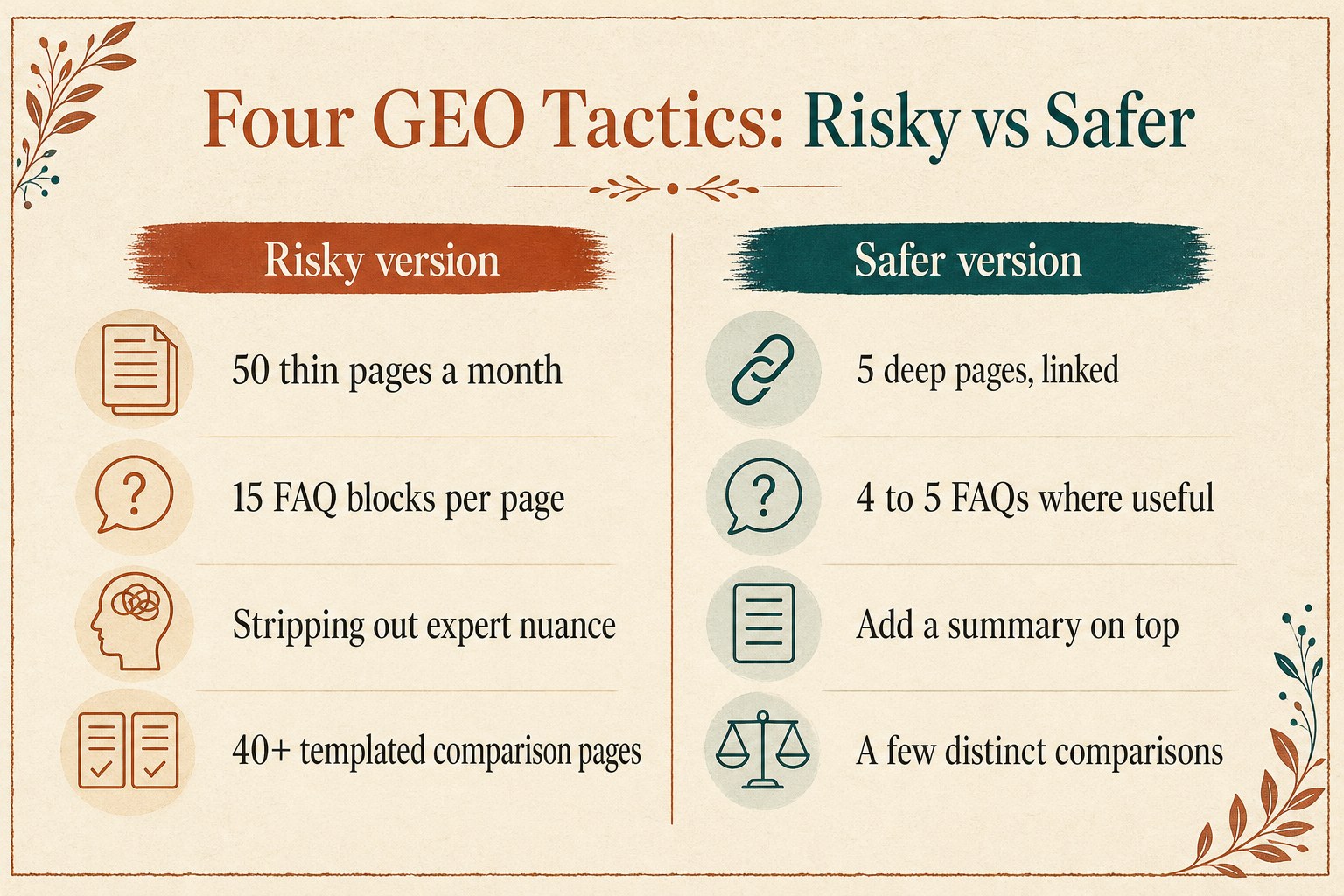
The four tactics and a safer version of each. The figures come from our March 20, 2026 post.
Why losing Google rankings costs AI visibility too
Most people treat Google and AI search as separate channels with separate rules. We argued against that in March and cited a figure: 71.7% of ChatGPT citations come from pages with organic search presence. The figure is real but narrower than that sentence. An Ahrefs study published on October 28, 2025 took the 1,000 pages ChatGPT cited most in September 2025 and found that 717 of them (71.7%) had organic keywords, a median of 279 per page, while 283 (28.3%) had none. Ahrefs listed fresh pages and narrow topics among its explanations for that second group.
We also wrote that Perplexity and Gemini show similar patterns, and that AI engines lean on pages that already rank because they don't keep an independent index of the whole web. For Google's AI features I can check that: Google's AI guide says they are "rooted in our core Search ranking and quality systems." For Perplexity I found no checked figure. Ray's explanation is retrieval-augmented generation, where an AI answer first fetches pages from a search index and then writes from them, so a page that isn't indexed and ranking "cannot enter the model's context window." The two channels are tied closely, then, without being one channel.
So, the "we 10x'd our AI citations" case studies annoy me because typically they don't include Google traffic results for those same weeks. I know Ray is also annoyed about success stories without the crash after growth. Plus, it's difficult to save AI visibility. Ahrefs analyzed 43,000 keywords. On November 11, 2025, they released the data. Here are the results: Google AI Overviews (the AI-generated snippets that appear above search results) were changing on average every 2.15 days. Consecutive observations had 54.5% of cited URLs in common. So, 45.5% of sources were new each time. We attributed 45.5% to regenerating the query, but this study is only for Google AI Overviews.
We've seen consistent growth in AI citations for sites that maintain good Google ranks and implement AI-friendly structure (as per our tracking) and first seeing big initial jumps and then drops for both on sites that abandon google performance. Can't re-run that from here unfortunately. We summarized the latter case as draining the pool that you're swimming in.
The platforms have written the pattern down too. Search Engine Journal reported on February 27, 2026 that Microsoft had rewritten Bing's webmaster guidelines. The page I read on November 19 says SEO best practices "support long-term visibility across Bing, Copilot, and AI-powered search experiences" and lists "Automatically Generated Content at Scale" among practices that "may be excluded from indexing." We also said in March that ChatGPT's quality filters were tightening, based on sites we tracked with big drops in ChatGPT mentions. The closest public evidence I found is the comparison-page site in Ray's article, whose ChatGPT citations fell in late January 2026.
And then we said that Google was working on opt out controls for AI features. On June 3rd, 2026, Google had 9 months to create publisher controls to prevent publishers' content appearing in AI features like AI Overviews. It was ordered to do so by the UK Competition and Markets Authority.
What helps both channels
In our March post, we were estimating about 70-80% overlap between good SEO practices and good GEO practices. It was an estimate from our own tracking (I could not find a publicly available study to back that up). Google's AI advice page and Bing's page both mention how good SEO practices are the foundation of visibility for their AI functionality. So that aligns with our direction, though not necessarily the degree. We outlined which SEO tactics are likely to help you with both SEO and GEO. That would include giving direct answers to the top of your major sections, clear and direct. Also, using FAQ schema on pages with useful questions. And building topical authority with content clusters. Also: make sure page speed is fast, your technical SEO is good. Do not block AI crawlers in your robots.txt file. Include an llms.txt file to point AI models to your most valuable content. Also, use Article schema and make sure your dateModified data is accurate. And use comparison tables, structured data, as applicable.
Two of those need correcting. FAQ schema no longer earns a rich result in Google. On llms.txt, Google's changelog records a note added to its AI guide on June 15, 2026, and the guide says Google Search ignores such files and that keeping one will "neither harm nor help" visibility there. I found no checked evidence about other engines. The dateModified item stands, with Ray's caveat about artificial refreshing, meaning edits made only to justify a new modified date.
The tactics we flagged as helping GEO but risking SEO are mass-producing thin answer pages (safe at 3 to 5 a month, dangerous at 20 or more), rewriting existing content for AI readability (safe when additive, risky when subtractive), and over-indexing on FAQ schema across a site. The other two are creating dozens of templated comparison pages and removing opinion, nuance and experience to make content cleaner. The 3 to 5 and 20 thresholds are our rule of thumb, not a published limit. Google's helpful content page asks a similar question, whether content is "primarily made to attract visits from search engines." We reduced it to one: does the tactic add value for human readers, or does it only exist to game an AI model? A page you'd be embarrassed to show a customer, we wrote, probably shouldn't exist.
What recovery costs
We put recovery from a Google quality demotion at 3 to 6 months, the typical timeline we see after a core update hits a site that over-indexed on thin AI-optimized content. Google's core update documentation (last updated December 10, 2025) says some changes take effect in a few days but "it could take several months" for its systems to confirm a site is producing helpful content, which can mean "waiting until the next core update." The Search Status Dashboard, which I opened on November 19, lists 2026 core updates on March 27, May 21 and November 10, so a site that missed recovery in May's update waited 173 days for the next one. Ray adds that many sites hit by Google's 2023 helpful content update haven't recovered to this day.
The math from our March post runs like this: a site with 10,000 organic visits a month at a 2% conversion rate makes 200 leads a month, a 30% traffic drop costs 60 of them, and a 4-month recovery costs 240. AI search sends under 1% of traffic to most sites, so even a perfect GEO program might add 100 visits a month. At 4.4 times the conversion rate that is about 9 extra leads (100 visits at 2%, times 4.4, is 8.8) against 60 lost.
What to do instead
The checklist from our March post has four steps. First, measure: baseline Google rankings for your target keywords and AI citations across ChatGPT, Perplexity, Claude and Gemini before you change anything, because the hard part is catching the moment something stops working. Google's AI guide points to the Generative AI performance report in Search Console for its own features, and RankControl's AI visibility tracker tracks citations across 7 AI engines: ChatGPT, Perplexity, Claude, Gemini, Grok, Google AI Mode and Google AI Overviews.
Second, audit structure, not quality: list your top 20 pages by Google traffic and check each for a direct, quotable answer in the first paragraph, FAQ schema where questions fit and comparison tables where they help, since most pages need structural additions, not rewrites. Third, build depth: 5 useful pages that each go deep on one question and link into a cluster, in place of 20 thin ones, because AI models and Google both look for depth on a topic. Fourth, monitor weekly. Ahrefs' 2.15-day average for AI Overviews is a measured reason a monthly check is too slow, and Google rankings swing around core updates like the one that began on November 10.
I think 10-15 hours for the initial audit and 3-5 hours a week for ongoing maintenance (compared to 3-6 months for getting over a quality demotion).